Garage Door Spring Repair in Utica, NY
Spring repair around Utica comes down to fitting a replacement matched to what your door weighs, then balancing the door so the opener and your own arm just guide it again.
Was there a loud crack from the garage, with the door now stuck shut or rising only a few inches? Odds are a spring snapped. Don't touch the door before you've read this page.
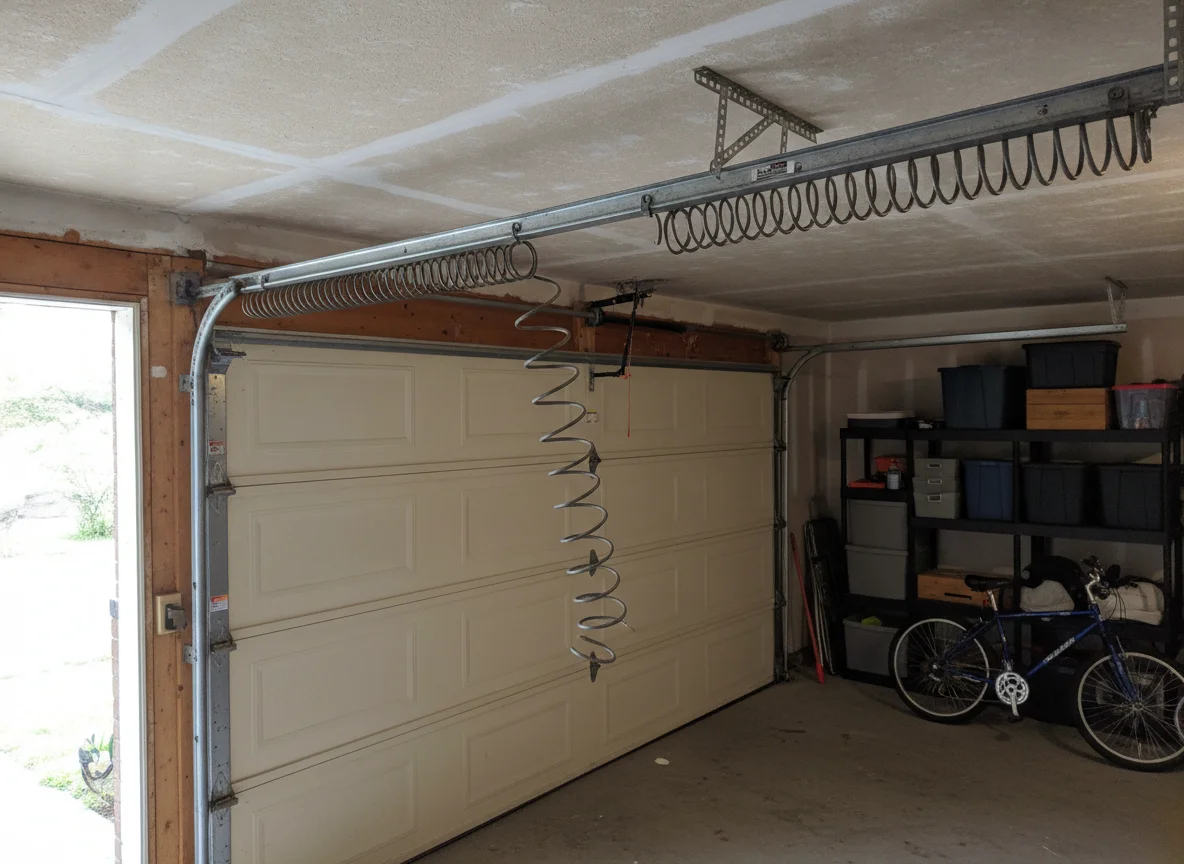
Spotting a broken spring
A crack like a gunshot, often while nobody was near the door. A torsion spring carries its heaviest load when the door is down, which is why so many finally fail in that position.
A split in the coil
Standing under a shut door, study the shaft overhead. A failed torsion spring leaves a neat break, often wide.
The door has turned very heavy, or slides back down when lifted by hand.
The opener whines or hums, and the door budges only a hand's width
Plenty of openers sense the extra load and back off, which is why the motor gets blamed for it.
The door rises lopsided, one side ahead. With a spring beside each track, one of the pair has lost its tension.
The door falls fast over the final foot when it should ease down.
Heard a crack, and now the door won't go up? Keep it down and describe what you see over the door.
Contact UsMaking it safe until repair
A wound spring holds enough force to break bones, and with one snapped, the door's full weight hangs from whatever remains. Until someone repairs it:
Resist lifting the door by hand and pressing the opener again and again
Lifting that weight isn't what the opener is for, and repeated tries may strip its drive gears.
Don't tug the red release handle while the door is raised
Without a spring to hold it, the door can fall under its whole weight.
Never loosen, wind or tweak a torsion spring on your own
The winding cones hold the force, and that's where this trade's worst injuries happen to people.
Kids and pets stay well back, and the car goes elsewhere if the door is jammed halfway open.
A vehicle trapped inside? Say so when you call.
Torsion versus extension springs
Torsion springs sit on a steel shaft over the closed door. Twisting stores force and turns the drums that reel in the lift cables.
Most newer doors have them. They lift more evenly than extension types and are less hazardous when they fail, because a broken spring stays on its shaft.
Extension springs run parallel to the horizontal tracks and lengthen as the door lowers. They show up on older, lighter doors. Every one should have a safety cable through it, because a spring that snaps without one can whip across the garage.
If you find none on yours, add one, whether or not a spring has failed.
Many older extension-spring doors can be switched to torsion springs, and it's reasonable to ask about that while the door is already being worked on.
What a spring job involves
The failed spring gets measured, then matched
Wire gauge, inside diameter, length and winding direction all count. Get any one wrong and the door never balances.
The door's weight decides which spring
The correct spring is the one sized for your door, not the nearest match in the van.
The old spring is removed in a controlled way, with the force released before any bolt is loosened.
The new spring is mounted and wound or set, and the cables are inspected at the drums so both sides climb together.
Balance check and test run
Disconnected from the opener, the door ought to stay near waist height wherever you leave it, then travel up and down cleanly under power.
Describe what the door is doing
Two sentences will do. You needn't know the name of the broken part, just what you saw and heard.
One spring or a pair?
With a two-spring door, both have raised the same door the same number of times. Once one breaks, the other is generally not far behind.
Fitting both at once spares you a second trip and keeps things level, since a fresh spring beside a worn one drags unevenly.
Ask what they advise for your door and why, in writing, as the New York State Attorney General's Office suggests. With one spring, ask about two.
Factors behind the cost of a spring job
Torsion or extension design, plus one spring or two on torsion.
Door dimensions and weight
Wide, wooden and insulated steel doors weigh enough to need heavier springs than a lightweight single door.
How hard the door is used
Springs are built for a certain number of open-and-close rounds. A tougher spring costs more and holds up better on a door that goes up and down all day.
Other worn parts
Cables fraying at the drums, rollers that drag, or worn shaft bearings cost less to deal with on the same visit as the spring than on a later one.
Converting from extension to torsion springs, should you choose to.
How long do springs last?
Use matters far more than age. A spring on a door that goes up four times a day outlasts the same spring on the family's main entrance, which may run through ten times as many trips.
Utica's valley setting and north winds make it colder than other Great Lakes cities, and springs often snap on the first hard-frost mornings.
If yours failed earlier than expected, ask about a spring built for more rounds.
The extra cost tends to be small next to a second repair.
If the spring isn't the cause
The spring seems whole, yet the door hangs askew or a cable has gone slack
Go to garage door cable repair.
Nothing is broken, but it runs loudly or slowly
A maintenance visit spots wearing springs while they still work.
Questions people ask
Can I swap a broken garage door spring on my own?
Extension springs, with safety cables fitted and the door raised and clamped, are a job some homeowners tackle.
Torsion springs are not. Winding one takes proper bars and the exact spring specification, and one slip sends the stored force straight through your hands. Hiring out here is about safety as much as convenience, and it is the one garage door repair where that holds true.
Can I force the door up to get my car out?
No, not with a broken spring. Leave the door shut and mention the car when you call us.
Why did it break while no one was using the door?
A spring tires a little each trip, and a torsion spring is wound tightest with the door down. The final snap often comes then, and cold turns spring steel brittle. It's wear, not a sign that something else is wrong.
Does a replacement spring mean a new opener?
Seldom. After a spring failure the opener may have been straining, so check that its drive gears haven't stripped.
Our other services
Garage Door Cable Repair
Frayed, snapped or slipped lift cables and doors hanging at an angle.
Read more →Garage Door Opener Repair
Openers that hum, reverse or ignore the remote, plus new ones when fixing makes no sense.
Read more →Garage Door Maintenance
A check of springs, cables, rollers and the auto-reverse feature before any of them fails.
Read more →Contact us
Tell us if the door is single or double, what the noise was like, whether the door moves at all, and whether a car is trapped inside.
A floor-level photo of the spring above the closed door shows its type and exactly where it broke.